
ESTABLISHING ALIGNMENT WITH TRUTH
While identifying distortion (the previous topic) is about spotting what’s wrong, establishing alignment is about actively building what’s right — calibrating your beliefs, decisions, and understanding as closely as possible to reality.
Core Principle
Truth alignment is not a feeling or a narrative. It is a process of iterative calibration between your map (what you believe) and the territory (what actually exists). It requires humility, rigor, and continuous updating.
Step-by-Step Framework: How to Establish Alignment with Truth
1. Start with Radical Epistemic Humility
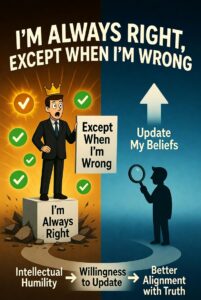

I’m Right, Right?
Am I Sure?
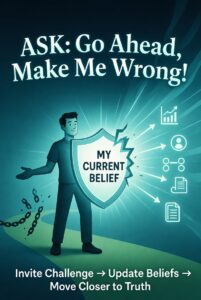
Prove Me Wrong!
Accept that you are probably wrong about many things.
Questioning one’s own beliefs is a sign of healthy intellectual humility and calibrated confidence.
The valuable mindset of holding strong opinions while remaining open to being wrong — the sweet spot between arrogance and excessive doubt.
Default stance: “I don’t know” is often more accurate than strong certainty.
This is a sign of healthy intellectual humility and calibrated confidence.
It is a valuable mindset of holding strong opinions while remaining open to being wrong — the sweet spot between arrogance and excessive doubt.
Ask: “What evidence would convince me I’m mistaken?”
Visualize the rare and courageous mindset of actively inviting others to disprove your beliefs — one of the fastest ways to align more closely with truth.
2. Demand High-Quality Foundations

Show Me The Data
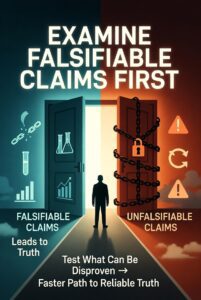
False Things First
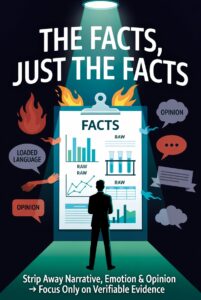
Just the Facts
Base beliefs on primary evidence (raw data, direct observations, replicated experiments) rather than summaries, opinions, or authority.
Keep a no-nonsense demand for raw, verifiable data instead of summaries, stories, or opinions — a cornerstone of serious truth-seeking.
Prioritize falsifiable claims — those that can, in principle, be disproven.
This reinforces a key principle of effective truth-seeking: prioritize claims that can actually be tested and potentially disproven, as they allow us to make real progress toward understanding reality.
Reject claims that rest solely on unfalsifiable assertions, circular reasoning, or appeals to emotion.
Develop a disciplined demand for raw, unadorned evidence while visually clearing away everything else.
3. Apply Multi-Lens Verification

Consistency, Consistency
Analyze This
Be Mr. Spock
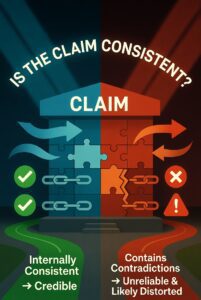
Internal consistency: Does the claim contradict itself?
External consistency: Does it clash with well-established, replicated facts?
One of the quickest and most reliable checks in truth-seeking: internal consistency. A claim that contradicts itself rarely survives serious scrutiny.
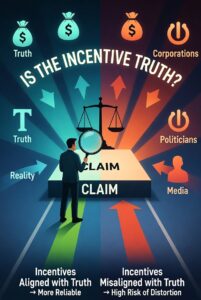
Incentive analysis: Who benefits if this is widely believed? Are the incentives aligned with truth-telling?
Representativeness: Is the data comprehensive, or cherry-picked?
One of the most important questions in truth-seeking: Are the people promoting this claim incentivized to tell the truth, or are they incentivized to push a particular narrative?
Language check: Strip away loaded/emotional words and test the neutral core.
Strong emotions (fear, anger, outrage, moral superiority, etc.) can fog our ability to think clearly and evaluate claims objectively.
4. Use the “Too Good to Be True” Filter



Really?
Nothing’s Perfect
Look Behind The Curtain
Extraordinary claims require extraordinary evidence.
When a claim is so extraordinary or outrageous that it demands serious scrutiny.
When a claim is so extreme that it “staggers the mind,” it should trigger your highest level of skepticism and demand exceptionally strong evidence.
Claims with no visible downsides, trade-offs, or costs are almost always distorted or incomplete.
When something sounds unrealistically perfect with no visible trade-offs or downsides, it almost always deserves extra scrutiny.
Ask: “What are the hidden costs or counter-evidence being omitted?”
a powerful humility-based question that helps uncover blind spots and hidden information: the mindset of intellectual humility — the willingness to admit that your current view might be incomplete and actively looking for what’s missing.
5. Seek Steelman Counter-Arguments



Identify Counter-arguments
Good Point!
Start Over
Identifying potential counterarguments is a crucial step in mastering the steel man argument. It requires you to put on the hat of an opposing party and anticipate their concerns, questions, and objections. To do this effectively, start by analyzing the topic at hand. Consider what aspects of it might be contentious or open to interpretation.
Actively search for the strongest version of the opposing view — not the weakest strawman.
The practice of steelmanning — deliberately seeking and engaging with the strongest version of the opposing argument rather than the weakest.
Intentionally engaging with the best, strongest version of the opposing argument rather than a weak strawman. It’s one of the most effective habits for reducing bias and moving closer to truth.
If you cannot accurately state the best counter-argument, you do not yet understand the issue well enough.
Emphasizes the value of revisiting, double-checking, and rethinking claims with fresh eyes.
The humble and effective practice of slowing down to re-evaluate a claim instead of accepting it on the first pass.
6. Test Through Prediction and Experiment


Think Straight
Time For A Test
Use A Scorecard
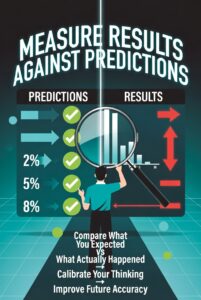
Good alignment produces accurate predictions about future events or unseen aspects.
The ongoing process of truth-seeking: not claiming perfect knowledge, but actively working to make your understanding (the map) align as closely as possible with reality (the territory).
Where possible, run small personal experiments or look for natural experiments in the real world.
Truth-seeking is not a one-time event, but an ongoing process of testing and refining our beliefs as we go.
Track your own prediction accuracy over time (this is one of the best personal calibration tools).
One of the most powerful truth-seeking habits: regularly testing how well your predictions match reality and using the feedback to update your beliefs.
7. Update Incrementally and Proportionally
Be Flexible
Strength Matters
Adjusting To Victory
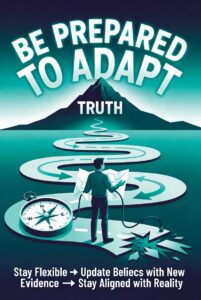
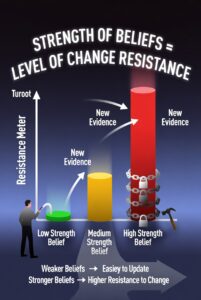
Change your beliefs in proportion to the strength and quality of new evidence.
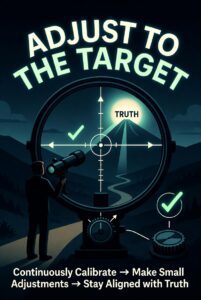
Be willing to change direction when reality shows your current path needs adjustment.
Strong prior beliefs should require strong disconfirming evidence to shift.
Weak or speculative beliefs should update more easily.
A key psychological truth: The stronger we hold a belief, the more resistant we become to changing it — even when evidence suggests we should.
Celebrate updating as a win — it means you moved closer to truth.
The disciplined practice of regularly fine-tuning your beliefs and understanding to stay accurately pointed at reality (the target).
8. Build Feedback Loops


Build Community
Routine Checkups
Write It Down
Surround yourself with people who prioritize truth over tribe (even when they disagree).
While individual truth-seeking is powerful, forming a strong team of honest, rigorous thinkers who challenge each other constructively dramatically increases your ability to stay aligned with reality.
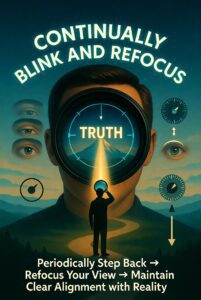
Regularly revisit important beliefs with fresh eyes.
The important practice of periodically “blinking” — stepping back from your current view to clear mental fatigue and refocusing with fresh eyes to maintain accurate alignment with truth.
Keep a “belief inventory” and note confidence levels + supporting evidence.
The disciplined practice of not just collecting data, but documenting it clearly and objectively rating its quality — a key habit for serious truth-seekers.
“Document And Rate The Data” is the practice of systematically recording where every piece of information comes from and then objectively evaluating its quality and reliability. Instead of treating all data equally, you assign clear ratings (high, medium, or low confidence) based on factors like source credibility, methodology, replication, and potential biases. This disciplined habit prevents weak or distorted evidence from contaminating your thinking and creates a transparent foundation for better decision-making and truth alignment.
Quick Diagnostic Questions for Alignment
- Can this claim be disproven? If not, treat it as low-confidence.
- What is the strongest evidence against it?
- Would I accept this exact standard of evidence if it supported the opposite conclusion?
- Does the claim survive translation into neutral language?
- After removing all emotional framing and incentives, does anything solid rema
Practical Mindset
Establishing alignment with truth is less like winning an argument and more like tuning an instrument. It’s ongoing, sometimes uncomfortable, and never perfectly finished. The reward is clearer thinking, better decisions, and resilience against manipulation.
This framework pairs perfectly with the earlier “Identify Distortion” tools. Together they form a robust truth-seeking system: detect what pulls you away from reality, then actively move toward it.