AGREEMENT ENFORCES OUTCOME
“Agreement enforces outcome” is a powerful principle that explains how mutual consent transforms intentions, promises, or directives into reliable, often self-sustaining results. Once parties reach genuine agreement, the shared commitment itself becomes a mechanism that drives or “enforces” the desired outcome — sometimes through internal motivation, social pressure, or external systems (like law), and often through a combination of all three.
This idea connects directly to our earlier discussions: just as directives through spoken word aim to produce action, agreement elevates those directives (or mutual commitments) by creating accountability and alignment. It turns “I want this” into “We will make this happen.”
When people explicitly agree, they experience a strong sense of personal obligation. This is rooted in consistency bias — humans prefer to act in ways that match their stated commitments to avoid cognitive dissonance.
Why Agreement Enforces Outcome
1. Psychological Commitment (Internal Enforcement)



My Word Is My Bond
The Unwritten Law
My Handshake Made Me Do It
A handshake deal or verbal “yes” often feels more binding than a casual suggestion.
The timeless principle of integrity—where promises are sacred and trust is earned through consistent action. It reminds us that credibility is not built by words alone but by honoring them. When we commit and follow through, our word becomes a reflection of our character, forming the foundation of respect and reliability that strengthens every relationship.
In psychology, this relates to psychological contracts (unwritten expectations in relationships or employment). When the agreement is perceived as broken, it triggers negative outcomes like reduced trust, effort, or loyalty.
There is an invisible framework of psychological contracts—the expectations and understandings that exist beyond formal agreements. In relationships and workplaces alike, these unspoken rules shape trust, loyalty, and fairness. They remind us that integrity extends beyond what’s written; it lives in mutual respect, empathy, and follow-through. When we honor these unseen commitments, we strengthen the bonds that make collaboration and connection truly meaningful.
Result: The agreement creates internal pressure to follow through, making the outcome more likely even without external force.
The inner force of commitment—the psychological pressure that arises once an agreement is made. A handshake symbolizes more than consent; it binds our integrity to action. This image reflects how promises create accountability, compelling us to follow through even when challenges arise. The handshake becomes a moral contract, reminding us that our word carries weight and our actions must honor it.
2. Social and Relational Enforcement
Agreement signals mutual buy-in, which activates social norms like reciprocity, reputation, and accountability.



Use A Witness
All For One
I Do = We Do
Others witness or know about the agreement, raising the cost of backing out (loss of trust, embarrassment, damaged relationships).
Social accountability amplifies commitment. When others witness an agreement, the handshake becomes more than a private promise—it transforms into a public pledge. The presence of a witness raises the cost of backing out, reinforcing integrity through shared observation. This image captures the subtle power of reputation and honor: once our word is seen and acknowledged, we feel an inner drive to uphold it, not just for ourselves but for those who trust us to keep it.
In teams, families, or long-term partnerships, “We agreed” becomes a powerful reminder that enforces behavior without constant supervision.
Theee is strength of collective commitment—the invisible bond that forms when a group agrees to act as one. In teams, families, or partnerships, the phrase “We agreed” becomes a quiet but powerful force that guides behavior even when no one is watching. This image symbolizes unity built on shared purpose and trust, where mutual accountability replaces supervision. When everyone stands behind the same promise, cooperation becomes instinctive, and success becomes inevitable.
This is why public commitments (e.g., wedding vows, team goals) often produce stronger outcomes than private ones.
The transformative power of public commitment—how shared vows and collective goals strengthen unity. Whether in marriage, teams, or partnerships, declaring intentions openly turns private promises into communal accountability. When others witness our pledge, the bond deepens, and the drive to honor it grows. This image symbolizes how spoken commitments forge lasting trust and shared purpose, reminding us that success built together endures far longer than any solitary effort.
3. Legal and Formal Enforcement (External Backup)
In many contexts, agreement creates a binding contract that courts or institutions can enforce.
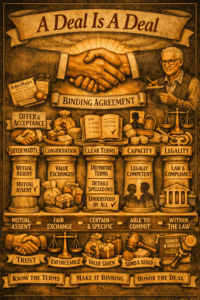
A Deal Is A Deal
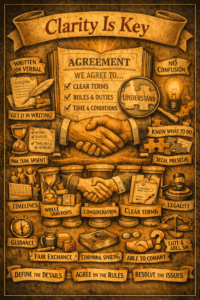
Clarity Is Key
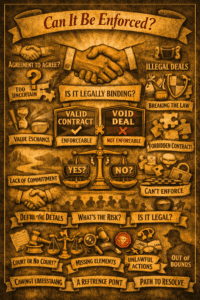
Can It Be Enforced?
Key elements for enforceability: offer + acceptance (mutual assent), consideration (something of value exchanged), clear terms, capacity, and legality.
If breached, remedies include damages, specific performance (forcing the action), or other penalties.
The foundation of enforceable agreements—the balance between promise and principle. Every valid deal rests on five pillars: an offer and acceptance that show mutual assent, consideration that gives value to both sides, clear terms that define obligations, capacity ensuring all parties can legally commit, and legality that keeps the agreement within ethical bounds. This image symbolizes how structure and trust intertwine—when these elements align, a handshake becomes law, and integrity becomes enforceable.
Even without courts, formal agreements (written or verbal in certain cases) set clear expectations and provide a reference point for resolution.
Transparent agreements—whether written or verbal—create stability and trust. When expectations are clearly defined, misunderstandings fade and accountability strengthens. This image symbolizes the power of precision in communication: clarity turns intention into structure, providing a shared reference point for resolving disputes and guiding future action. Even without formal enforcement, clear terms become the compass that keeps relationships and collaborations on course.
Not all agreements are enforceable (e.g., “agreements to agree” in the future often aren’t, or illegal deals).
There is a boundary between promises and enforceable agreements. Not every deal carries legal weight—some, like “agreements to agree” or arrangements involving illegal acts, lack the structure or legitimacy needed for enforcement. This concept reminds us that clarity, legality, and mutual assent are essential for turning intention into obligation. Without these elements, a promise remains just that—a statement of intent, not a binding commitment.
4. Practical and Behavioral Enforcement
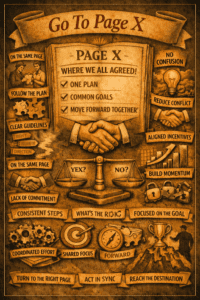

Go To Page X
Be Precise
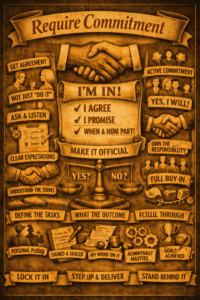
Require Commitment
Agreement reduces ambiguity and aligns incentives. Once everyone is on the same page, coordination improves, misunderstandings drop, and momentum builds toward the outcome.
The power of alignment through agreement. When everyone shares the same understanding—literally on the same page—ambiguity fades, coordination strengthens, and momentum builds. This image captures how clarity and shared purpose transform scattered efforts into unified progress. Agreement doesn’t just define direction; it synchronizes action, turning collaboration into a smooth, focused drive toward a common goal.
It turns vague directives into shared ownership.
There is transformative power of clarity in communication. When vague directives are replaced with specific, shared language, responsibility shifts from confusion to collaboration. Precision turns uncertainty into ownership—everyone knows what to do, how to do it, and why it matters. This image symbolizes how exactness builds alignment and accountability, ensuring that collective effort moves confidently toward the intended outcome.
In management or leadership, getting explicit agreement (“Do you commit to delivering this by Friday?”) dramatically increases follow-through compared to one-way commands.
Explicit agreement transforms leadership from command to collaboration. When people say “I’m in,” they move from passive compliance to active ownership. This image captures the power of mutual assent—how asking for commitment builds accountability, strengthens trust, and dramatically increases follow-through. In management and teamwork alike, clarity paired with consent turns direction into dedication.
How This Works in Practice
- Everyday Example: You and a colleague verbally agree on who will handle which parts of a project. The agreement enforces the outcome because backing out now feels like letting the team down — even if no boss is watching.
- High-Stakes Example: A signed contract for services. The agreement doesn’t just hope for delivery; it legally enforces it through potential lawsuits or arbitration if one side fails.
- Spoken Word Connection: When issuing directives, seeking and securing agreement (“Are we aligned on this?”) makes the directive far more effective than a unilateral order. The agreement adds commitment power.
Conditions That Strengthen “Agreement Enforces Outcome”
- Clarity: Vague agreements weaken enforcement (people interpret them differently).
- Genuine Consent: Coerced or misunderstood agreement often fails or backfires.
- Visibility: Public or witnessed agreements create stronger social enforcement.
- Consequences: Explicitly discussing what happens if the agreement isn’t met adds teeth.
- Alignment with Reality: The agreed outcome must be feasible; unrealistic agreements collapse under pressure.
Limitations
- Agreement alone doesn’t guarantee perfect outcomes — external factors, changing circumstances, or bad faith can interfere.
- Over-reliance on formal enforcement (courts) is costly and slow; the best agreements are self-enforcing through trust and incentives.
- In some cultures or contexts, relational enforcement (honor, reputation) is stronger than legal mechanisms.
This principle is foundational in law (contract theory), leadership (getting buy-in), psychology (commitment and consistency), and everyday coordination. It shows why clear, mutual agreement is one of the most reliable ways to turn words into results — it harnesses human nature, social dynamics, and (when needed) institutional power.
Tying back to truth-seeking and directives: An agreement aligned with truth (based on facts, not distortion) and issued through effective spoken (or written) communication is especially powerful because it rests on solid ground rather than manipulation or wishful thinking.